The Bill Comes Due
From Ukraine's Fields to the Strait of Hormuz

We all know the old saying, “those who don’t study their history are doomed to repeat it.” Well, here we go again — and I mean that quite literally. In June of 2022, I wrote a newsletter for this publication titled “The Coming of the 3rd Horseman.” I’d like to think it was one of the more prescient things I’ve put in front of you. At the time, I warned that Russia’s invasion of Ukraine had set the table for a potential global food crisis by disrupting the supply of the nitrogen, phosphorus, and potassium fertilizers that the modern world depends on to feed itself. In that piece, I leaned heavily on the work of geopolitical strategist Peter Zeihan, who warned bluntly that the disruption could generate “far lower crop yields on a global basis.”
Here is what saved us then: an unusually mild winter in Europe in late 2022. Because the winter was warmer than feared, European LNG demand was lower than projected. That meant more natural gas was available to run fertilizer plants. Crisis averted — or more accurately, crisis deferred.
There will be no mild winter to save us this time.
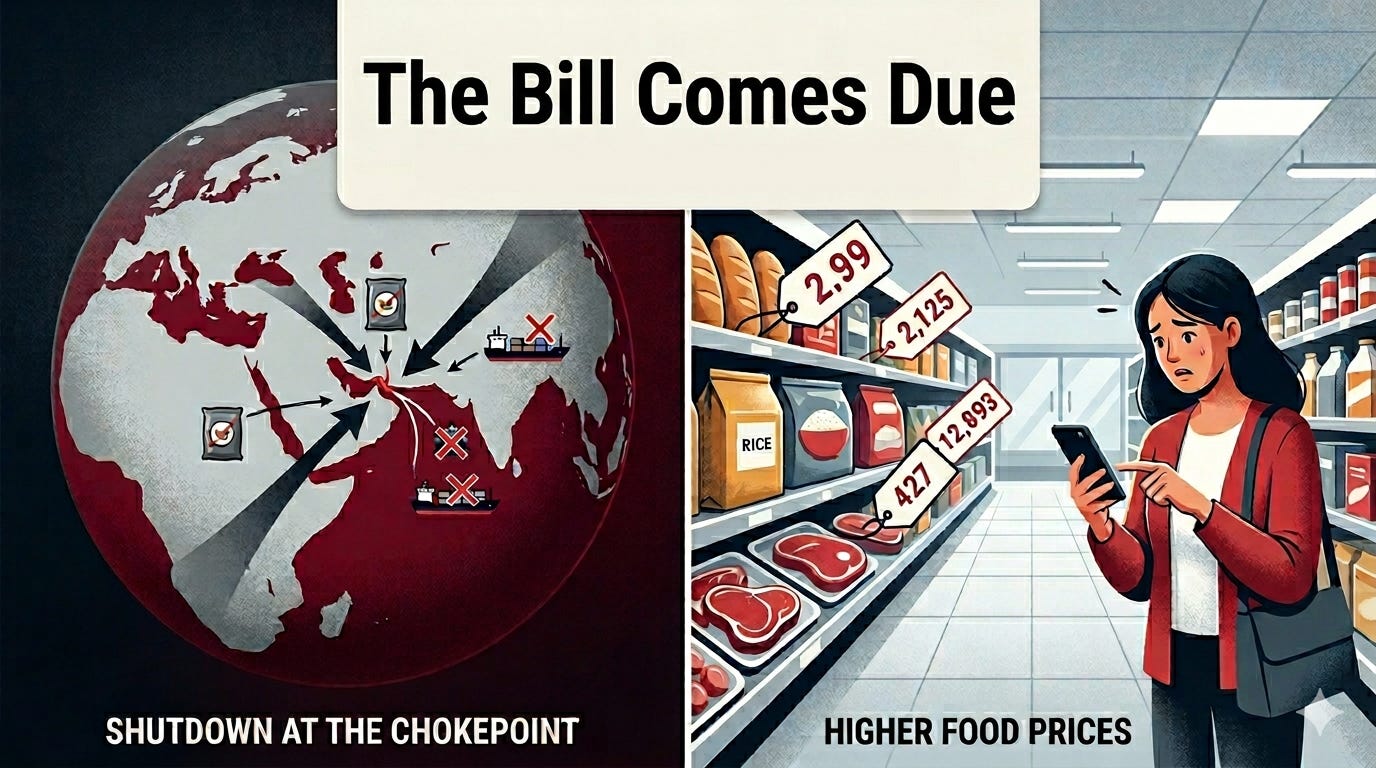
The U.S.-Israeli war with Iran, which began on February 28, 2026, has effectively shut down the Strait of Hormuz — a narrow passage between the Persian Gulf and the Gulf of Oman that most Americans couldn’t find on a map if their lives depended on it. But here’s the thing: what happens there is going to affect what you pay for food for months, possibly years, to come. And depending on where you live in the world, it could mean something far worse than a higher grocery bill.
The Fertilizer Trifecta, Revisited
Back in 2022, I introduced you to what National Geographic called the “chemical fertilizer trifecta” — nitrogen (N), phosphorus (P), and potassium (K). The combination of these three nutrients, I explained, “has enabled the greatest human population growth the planet has ever seen.” When Russia invaded Ukraine, the world lost access to a massive chunk of all three: Russia and Belarus together supplied over 40 percent of global potash exports, Russia alone accounted for roughly 22 percent of global ammonia exports and 14 percent of urea. The world scrambled.
Now we face a different chokepoint, but the same fundamental vulnerability. The Strait of Hormuz — only 21 miles wide at its narrowest point — is the exit ramp for the Persian Gulf’s fertilizer exports. Gulf countries like Qatar, Saudi Arabia, the UAE, and Kuwait have spent decades building enormous ammonia and urea production capacity. Qatar Fertiliser Company alone supplies roughly 14 percent of the world’s urea. As Fortune reported, nearly half of all globally traded urea — the most widely used nitrogen fertilizer — comes from Gulf countries, and almost all of it exits through the Strait.
Since the conflict began, tanker traffic through the Strait has dropped by more than 70 percent. Drone and rocket strikes have made maritime insurance costs prohibitive. And unlike oil, there are no strategic international fertilizer stockpiles to draw down. As Máximo Torero, chief economist of the UN Food and Agriculture Organization, told NPR: “The loss of Gulf exports creates an immediate global shortfall with no quick substitutes.” Urea prices have already surged roughly 40 to 45 percent since the conflict began.
In 2022, I noted that “Europeans have stopped producing nitrogen fertilizer because natural gas prices in Europe are now seven times what they are in the United States.” Today, the same dynamic is playing out globally. Fertilizer plants in India, Bangladesh, and Pakistan that depend on Gulf LNG to manufacture urea have already had to stop production. The problem is not just about what enters the Strait. It’s about the natural gas that doesn’t leave it.
The Worst Possible Timing
Here is a little chemistry that I also explained back in 2022. The Haber-Bosch process — developed by two German chemists in the early 20th century — synthesizes ammonia from nitrogen in the air using natural gas as a feedstock. This process is the foundation of modern agriculture. Without it, experts estimate the Earth could only sustain a fraction of its current population. Every time you eat a piece of bread or a bowl of rice, you are in a very real sense eating natural gas. And right now, a lot of that natural gas can’t get out of the Persian Gulf.
What makes this especially dangerous is the timing. As the IFPRI noted, fertilizers are applied early in the crop cycle and largely determine yield at harvest. Miss the spring planting window, reduce application rates, or skip fertilizer entirely, and you don’t get a second chance until next year. The Northern Hemisphere is preparing for spring planting right now. The clock is ticking.
The countries most immediately at risk read like a geography of global food production. India, the world’s largest rice exporter, relies heavily on Gulf LNG to run its domestic urea plants. Brazil, which accounts for nearly 60 percent of global soybean exports, depends substantially on imported nitrogen and phosphate fertilizers. In sub-Saharan Africa — where I noted in 2022 that fertilizer use was already critically low — even a modest price increase is enough to push farmers to skip applications altogether. The 2022 food price crisis left those populations with little buffer. They have even less now. As NPR reported, the FAO’s Torero says the countries facing the most immediate impact in South Asia are Bangladesh, India, Pakistan and Sri Lanka, in East Africa Sudan, Kenya and Somalia, and in the Middle East, Turkey and Jordan.
Peter Zeihan Was Right. He’s Still Right.
In my 2022 newsletter, I cited Peter Zeihan, geopolitical strategist and author, who warned that fertilizer disruptions would “generate far lower crop yields on a global basis” and that “the world will begin to see a food shortage in late 2022.” As I noted, a lucky mild winter softened that blow. But Zeihan’s underlying framework — that the global food system is built on a supply chain that has very few backup routes and almost no redundancy — has only become more relevant.
The 2022 shock was a warning shot. We didn’t restructure the supply chains. We didn’t diversify fertilizer production. We didn’t build strategic stockpiles. We got lucky with the weather, declared the crisis over, and went back to business as usual. Now the second, more severe version of the same shock has arrived — and this time there is no mild winter coming to bail us out.
American farmers are not immune. CNN reported that even before the war, the cost of nitrogenous fertilizer had risen 22 percent year over year. John Yeley, an Illinois corn and soybean farmer, told CNN he cannot even get suppliers to quote him a nitrogen price right now. “When I call a retailer,” he said, “I could not get a price on any nitrogen source out there.” Meanwhile, CNBC reported that Michigan farmer Matt Frostic, who sits on the board of the National Corn Growers Association, put it plainly: “We’re in uncharted territory. It’s like a code red.” He purchased nitrogen fertilizer in January for around $350 per ton. That same product is now closing in on $600 per ton. Even domestically produced American fertilizer will get more expensive, because its production cost is tied to natural gas prices, which have soared globally. The USDA had already projected, before the war started, that food prices this year would rise faster than in 2024 or 2025. Those projections now look optimistic.
The Inescapable Network of Mutuality
In my 2022 newsletter, I referenced a grim statistic that if the worst case materialized, “the potential population loss is essentially just over 1/7th of the world population.” I hoped that number would never be tested. We got lucky. Not so sure we will be as lucky this time.
The uncomfortable truth is that this crisis is not uniformly distributed. When fertilizer prices surge 40 percent, an Iowa corn farmer faces financial stress, and consumers see higher prices at Walmart. When fertilizer prices surge 40 percent in Bangladesh, Somalia, or Sudan, farmers can’t afford inputs, crops fail, and people go hungry. As the Carnegie Endowment for International Peace warned, “the more worrisome costs for the most vulnerable — those at the grocery store — are yet to come.”
You cannot build a new ammonia plant overnight. You cannot re-route four decades of Gulf fertilizer supply chains in a matter of weeks. As the Globe and Mail reported, even if the Iran war stops tomorrow, the production taken offline will not return quickly — and when it does, Qatar is more likely to sell its LNG to high-demand markets like China than prioritize fertilizer production. The world got a painful lesson in supply chain fragility in 2022. We apparently did not learn it well enough.
What This Means for You
A few practical observations for those of you who take these things seriously, which, based on the fact that you are still reading, I suspect includes all of you.
First, understand that the grocery price increases you are about to see are not primarily the result of corporate greed or domestic policy failures. They are the downstream consequence of a geopolitical disruption at a critical chokepoint in the global agricultural supply chain — the same type of disruption I warned you about in 2022. Wolfe Research chief economist Stephanie Roth estimates the disruption could raise “food-at-home” inflation by roughly 2 percentage points. Prices for corn, soybeans, wheat, and rice, and every food product made from them, will rise. Meat and dairy prices, tied to grain feed costs, will follow. This is not fear-mongering; it is arithmetic.
Second, from an investment perspective, agricultural commodities and fertilizer producers outside the Gulf region will likely benefit from this disruption. As CNBC noted, CF Industries hit an all-time high and shares are up nearly 10 percent over the past week — the company’s biggest multiday gain since 2022. Companies in North America, Eastern Europe, and Australia that produce nitrogen, phosphate, or potash fertilizers are positioned to capture market share. This is not a recommendation — I am not your financial advisor, and you should consult someone who is — but it is a logical implication of the supply shock.
Third, recognize that the Strait of Hormuz is not just an energy chokepoint. As current events are now demonstrating at scale, it is also a food security chokepoint. Every conversation about this war that focuses exclusively on oil prices while ignoring fertilizer is only telling you half the story. As Fortune put it, the fertilizer gap “is, in some ways, a more intractable challenge than the energy crunch.”
There is an old saying that “the definition of insanity is doing the same thing over and over and expecting a different result.” In 2022, the world received a clear warning about the fragility of its fertilizer supply chains. Rather than address that fragility — by diversifying production, building strategic reserves, or reducing dependence on a single geographic chokepoint — we got lucky with the weather and moved on. Now the Horseman that got deferred in 2022 is back in the saddle.
Eventually, the shooting will stop. The Strait will reopen and prices will ease. But the underlying vulnerability — a global food system dependent on a 21-mile-wide passage of water — will remain until someone has the will and resources to address it systematically. Given that we ignored the exact same lesson in 2022, I am not holding my breath.
In the meantime, watch your grocery bill. It is about to tell you everything you need to know about the price of ignoring history.
Et, al...

Movie Review: Project Hail Mary
Based on Andy Weir’s bestselling novel — the same author who gave us The Martian — the film follows Ryland Grace (Ryan Gosling), a middle school science teacher who wakes up alone on a spaceship light-years from Earth with no memory of how he got there. As his memory returns, he realizes he’s on a one-way mission to figure out why a mysterious microorganism is eating the Sun. Directed by Phil Lord and Christopher Miller, it’s part heady sci-fi saga, part irreverent buddy comedy.
And the Verdict is...
If you’re looking for the most fun you can have at the movies right now, get yourself to a theater to see Project Hail Mary. No foolzies, I promise!
What makes the film special is the friendship Grace develops with Rocky, an alien creature he encounters on a nearby spacecraft — one of the most unexpectedly charming on-screen partnerships in recent memory. At 95% on Rotten Tomatoes, critics are calling it “a near-miraculous fusion of smarts and heart.” In a week dominated by wars, economic shocks, and political chaos, Project Hail Mary is exactly the reminder that movies can still fill you with genuine wonder — and Gosling is absolutely at his best. See it on the biggest screen you can find!
If you enjoy what you’ve read here and you think I might have a clue what I’m talking about, then please reach out to me if you would like me to present to your firm or organization. I have experience talking to professional organizations, trade conferences, as well as universities. I’ve also appeared in newspaper articles and podcasts. Also, I’m available for birthdays and bar mitzvahs.